
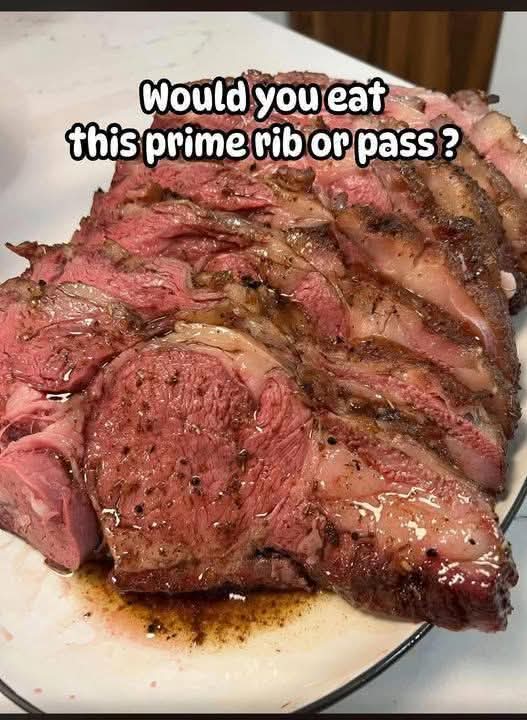
🥩 Perfect Prime Rib Roast
Prime Rib Roast is one of the most luxurious and impressive beef dishes you can serve. With its rich marbling, deep beef flavor, and melt-in-your-mouth texture, this roast is perfect for holidays, special dinners, or when you simply want to cook something unforgettable. This step-by-step guide will show you how to cook prime rib perfectly every single time, achieving that desirable juicy, tender, and restaurant-style result.
🍖 What Is Prime Rib? (Formation & Benefits)
Prime rib, formally known as a Standing Rib Roast, comes from the rib section of the cow (the sixth through twelfth ribs). Its desirable qualities—which define its appeal and flavor—are due to its location and high **marbling** (intramuscular fat).
- High Fat Marbling: The fat melts during cooking, self-basting the meat and delivering incredible flavor and juiciness.
- Incredible Tenderness: It comes from a section of the cow that is not heavily exercised.
- Juicy, Beefy Flavor: Rich, deep, and satisfying beef flavor, optimized when served medium-rare.
🛒 Ingredients (Serves 6–8)
For the Prime Rib and Seasoning
| Ingredient | Quantity | Notes |
|---|---|---|
| Prime Rib Roast | 1 (4–6 pounds / 2–3 kg) | Bone-in or boneless. |
| Olive Oil | 2 tablespoons | Binder for the seasoning paste. |
| Unsalted Butter, softened | 2 tablespoons | Adds richness and aids crust formation. |
| Garlic, minced | 6 cloves | Essential aromatic. |
| Kosher Salt | 1 tablespoon | Crucial for seasoning and moisture retention. |
| Freshly Ground Black Pepper | 2 teaspoons | |
| Fresh Rosemary, finely chopped | 1 tablespoon | Classic herb pairing for beef. |
| Fresh Thyme, chopped | 1 tablespoon | |
| Paprika | 1 teaspoon (optional) | For color and depth of flavor. |
Optional Add-Ons
For an extra layer of complexity:
- 1 teaspoon Onion Powder
- 1 teaspoon Dijon Mustard (mix with the seasoning paste)
📜 History of the Roast
Roasting large cuts of beef is a tradition that spans centuries, associated with feasts and celebration. The “Rib Roast” has been a staple of formal dining, particularly in Great Britain, where it was the centerpiece of a traditional Sunday dinner. The term “Prime Rib” originally referred to the highest quality grading of the cut (USDA Prime). Though often used generally today, the preparation—using high-heat searing followed by slow roasting—is a classic method designed to respect the quality of the beef and maximize flavor and tenderness, making it worthy of any special occasion.
🔪 Preparation & Seasoning (Methods)
Crucial Preparation Steps
- Bring to Room Temperature: Take the prime rib out of the fridge at least **2 hours** before cooking. This critical step ensures even cooking from edge to center and prevents a raw, cold core.
- Pat Dry: Pat the entire roast dry using paper towels. This removes surface moisture, which is necessary to achieve a beautiful, crispy crust (the Maillard reaction).
- Preheat Oven: Preheat your oven to $450^\circ\text{F}$ ($230^\circ\text{C}$).
Seasoning the Roast
- Create Herb Paste: In a bowl, thoroughly mix the olive oil, softened butter, minced garlic, salt, pepper, rosemary, thyme, and paprika (plus any optional add-ons).
- Massage: Rub this aromatic mixture generously all over the roast, making sure to cover the top, sides, and bottom. Massage the seasoning deeply into the meat and any crevices.
🔥 Cooking Method (Fail-Proof Reverse Sear)
We are using a modified slow-roast method, often called the “High-Heat Sear” technique, which is the most reliable method for achieving a perfect medium-rare center.
Step 1: High-Heat Sear
- Place the prime rib fat-side up on a rack in a roasting pan.
- Put it in the oven at **$450^\circ\text{F}$ ($230^\circ\text{C}$) for 20 minutes**. This initial high heat rapidly heats the surface, creating a desirable crust and locking in juices.
Step 2: Slow Roast
- Reduce the oven temperature to **$325^\circ\text{F}$ ($165^\circ\text{C}$)**.
- Continue roasting until the desired internal temperature is reached. Use a reliable meat thermometer inserted into the thickest part of the meat, avoiding the bone.
| Doneness (Formation Target) | Internal Temp (Remove from Oven) | Approximate Time per Pound (450°F + 325°F) |
|---|---|---|
| Rare | $120^\circ\text{F}$ / $49^\circ\text{C}$ | 12–13 min |
| **Medium-Rare (BEST)** | **$130^\circ\text{F}$ / $54^\circ\text{C}$** | **13–15 min** |
| Medium | $140^\circ\text{F}$ / $60^\circ\text{C}$ | 15–17 min |
Step 3: Resting (DO NOT SKIP)
- Remove and Cover: Remove the roast from the oven and cover it **loosely** with foil.
- Rest: Let the roast rest for **20–30 minutes**. The temperature will rise 5–10 degrees during this time (known as carryover cooking).
- **Benefit:** This essential step allows the muscle fibers, which tightened during cooking, to relax and redistribute the internal juices throughout the meat, resulting in a juicy, tender, and less dry final product.
🔪 How to Slice Prime Rib
Slicing correctly is key to tenderness:
- Use a sharp carving knife.
- Slice **against the grain** (perpendicular to the direction the muscle fibers run). This shortens the meat fibers, ensuring maximum tenderness in every bite.
- Thickness: about $1/2$ inch ($1–1.5$ cm).
- Serve immediately with the natural juices (au jus) from the pan.
🍽️ Best Side Dishes for Prime Rib
These classic pairings enhance the rich flavor of the beef:
- Creamy mashed potatoes
- Roasted garlic potatoes
- Green beans with butter or almonds
- Yorkshire pudding (a traditional partner)
- Horseradish sauce (for a sharp, tangy contrast)
- Simple green salad